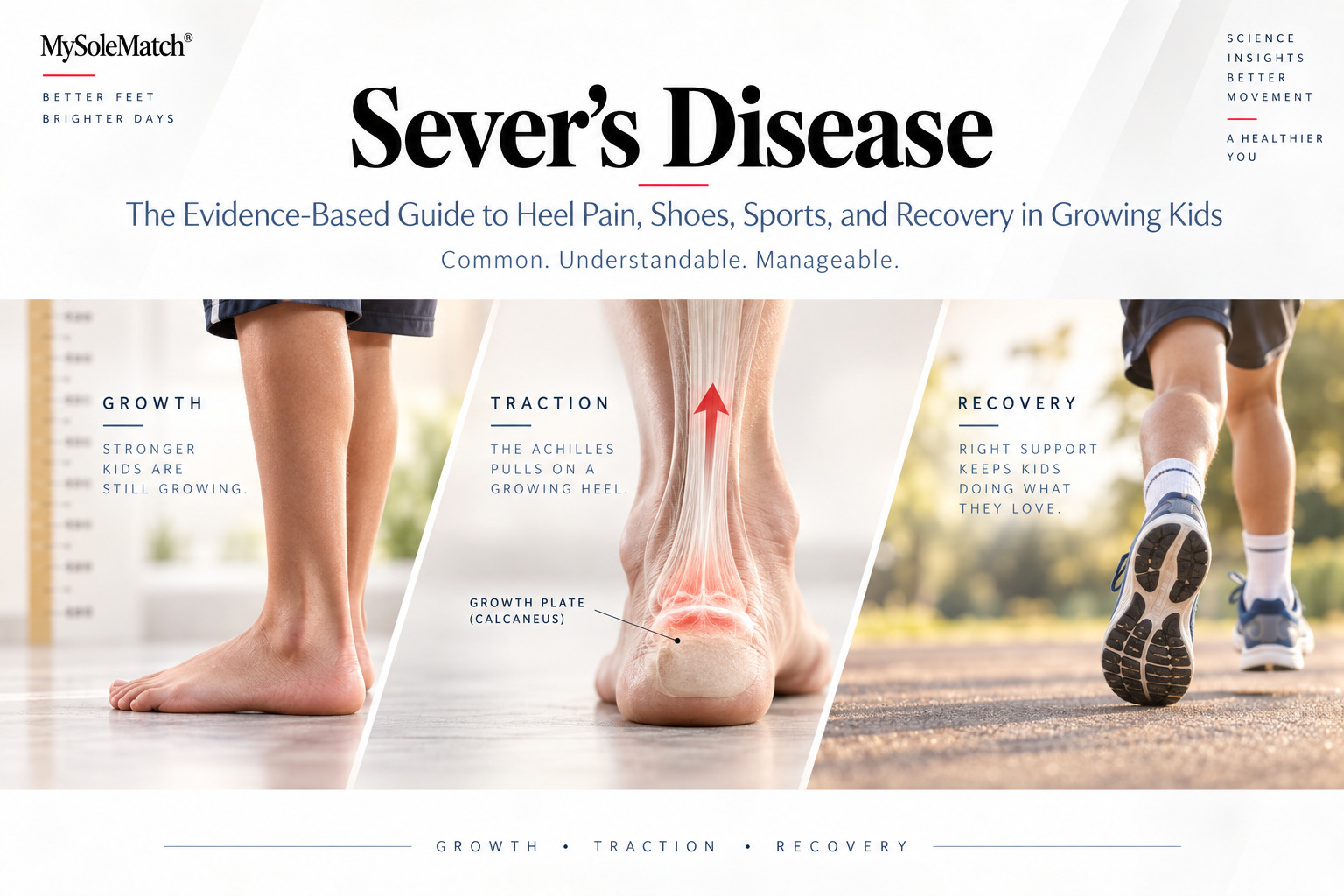
If your child just came home limping after practice, here's what "Sever's disease" actually means
If a coach, a trainer, or even a quick urgent care visit mentioned the words "Sever's disease," here's the first thing worth knowing: despite the name, this isn't a disease in the way that word usually sounds. It's the most common cause of heel pain in growing kids, and for most families, it's manageable, not alarming.
The clinical name is calcaneal apophysitis, apophysitis meaning irritation at a growth plate, calcaneal referring to the heel bone. It shows up during a very specific window: the years when a child's bones are growing faster than the muscles and tendons attached to them can comfortably keep up. The Achilles tendon anchors to a growth plate at the back of the heel, and during a growth spurt, that tendon pulls on a plate that hasn't finished hardening yet. Repeated pulling, from running, jumping, or just being an active kid, irritates that spot. That's the whole mechanism.
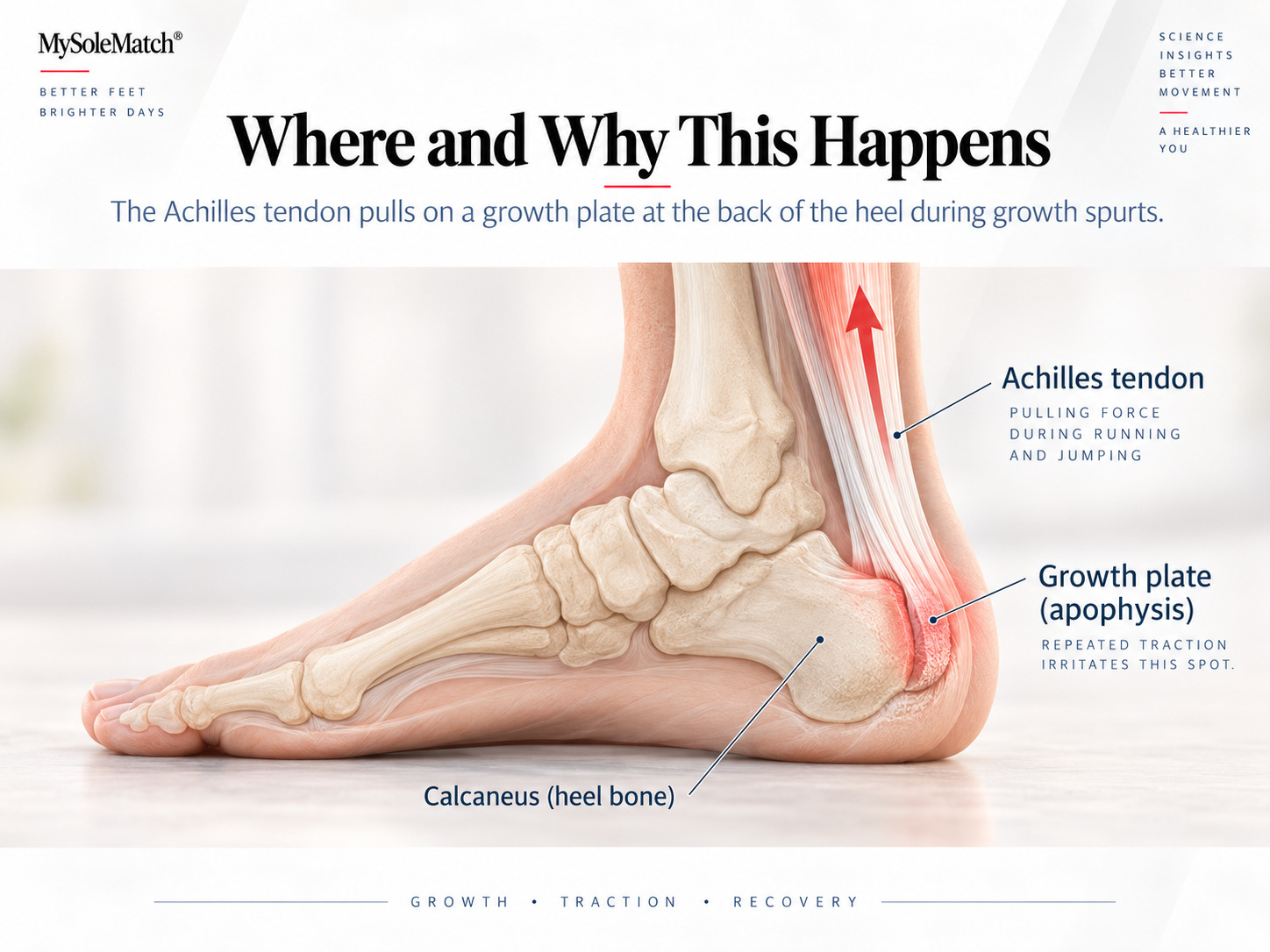
Where and Why This Happens
The Achilles tendon attaches to a growth plate at the back of the heel that hasn't finished hardening. Repeated traction from running and jumping irritates that spot during growth spurts.
Why the "typical age" you'll read online is misleading
Almost every source quotes the same range: 8 to 15. That's not wrong, but it flattens something real and useful into a single meaningless number.
Girls and boys tend to hit this window at different ages, because they hit their growth spurts at different ages. A four-year hospital-record study out of Istanbul, reviewing nearly 21,000 pediatric patients, identified 74 confirmed cases and found girls presenting at a mean age of 9.28 years (range 6.87 to 13.20), compared with 11.14 years in boys (range 8.04 to 15.73). Same pattern every time this gets studied: girls earlier, boys later, both sitting comfortably inside that "8 to 15" range that gets quoted without explanation.
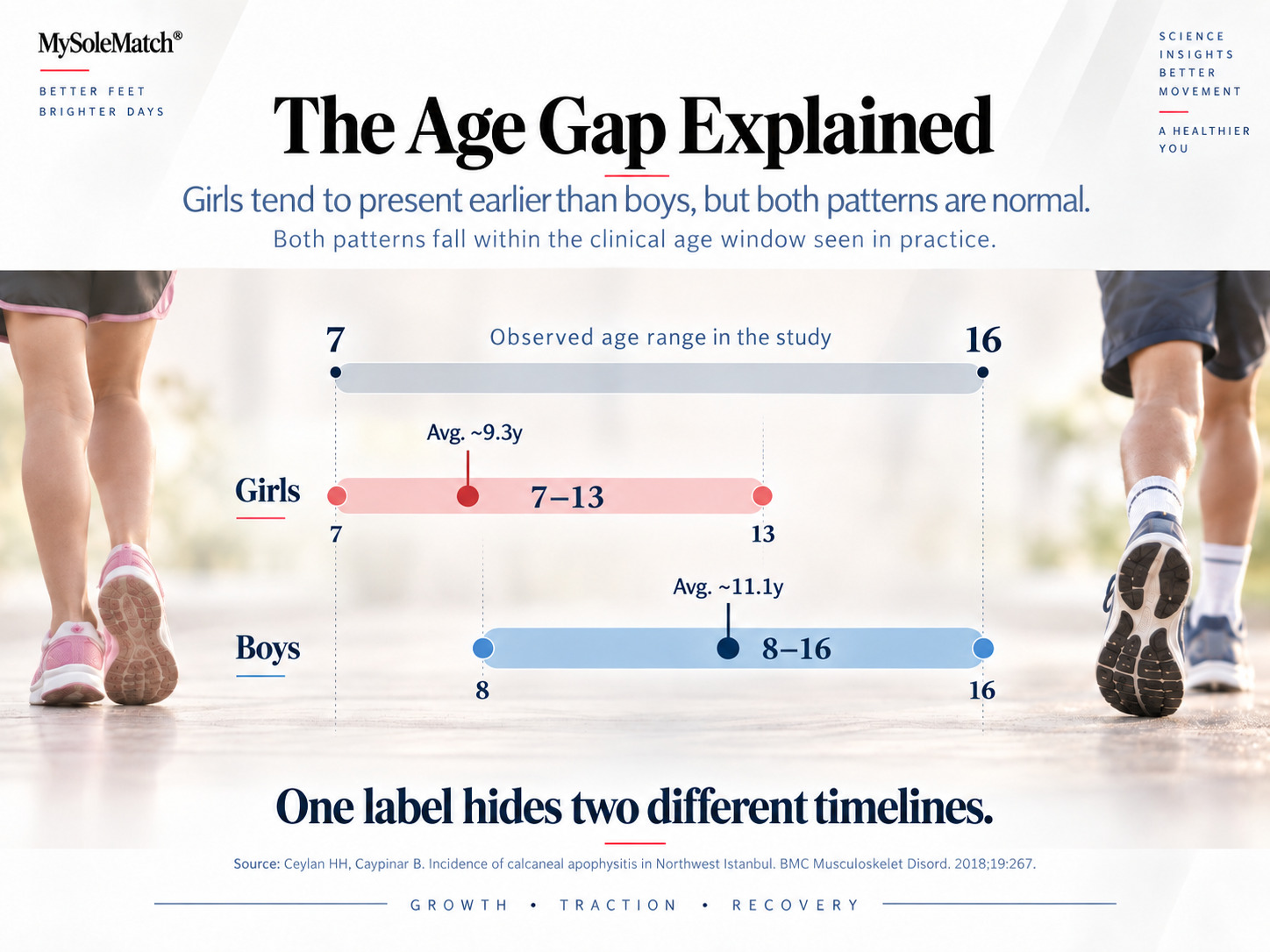
The Age Gap Explained
Girls typically present years earlier than boys, both patterns are normal, and both sit inside the commonly quoted 8-15 age range.
That's worth knowing because it means an 8-year-old girl and a 14-year-old boy can both have a textbook case of the same condition, and neither one is outside the "normal" window, even though their ages look nothing alike.
What actually causes it, and the claim that doesn't hold up
Search around and you'll find a persistent idea that overweight or overly active kids are the ones who get this. It's a tidy explanation. It's also not well supported by the research.
A 2011 prospective study looking specifically at risk factors found no evidence that body weight or activity level predicted who developed symptoms. That doesn't mean activity is irrelevant, running and jumping are clearly what triggers the traction on the growth plate in the first place, but it does mean "your child is too heavy" or "your child plays too much" isn't the explanation the evidence actually supports.
A 2023 systematic review pooling 11 studies and 1,265 children took a more structured look at what does correlate. The single most frequently studied and most consistently implicated factor was limited ankle dorsiflexion, essentially, tighter calf and Achilles flexibility restricting how far the ankle can bend upward. Foot alignment and how pressure distributes across the foot during walking also came up repeatedly. The review's own authors were candid that the field hasn't reached full agreement on which factors are causes versus which are just associated with the condition, an honest, useful distinction that most parent-facing content skips entirely.
Does my child need an X-ray?
Usually, no, and here's the actual clinical reasoning, not just the answer.
Sever's is typically diagnosed by physical examination alone, tenderness at a specific spot on the back of the heel, combined with the child's age and activity pattern, is usually enough. Imaging tends to enter the picture when something doesn't fit that typical pattern, pain that isn't tied to activity, pain in an unusual location, swelling, or a presentation that makes a clinician want to rule out something else, a stress fracture, for instance. When X-rays are taken, they often show fragmentation or increased density at the growth plate, but importantly, those same features can also appear in completely pain-free kids, which is part of why imaging isn't the default diagnostic step. Whether your child's presentation warrants imaging is a judgment call for whoever's examining them, not something to decide from a search result.
What actually helps, and what the evidence says clinicians tend to try first
This is the part where a lot of content oversimplifies into "just get a heel cup." The real picture is more layered, and being honest about that layering is more useful, not less.
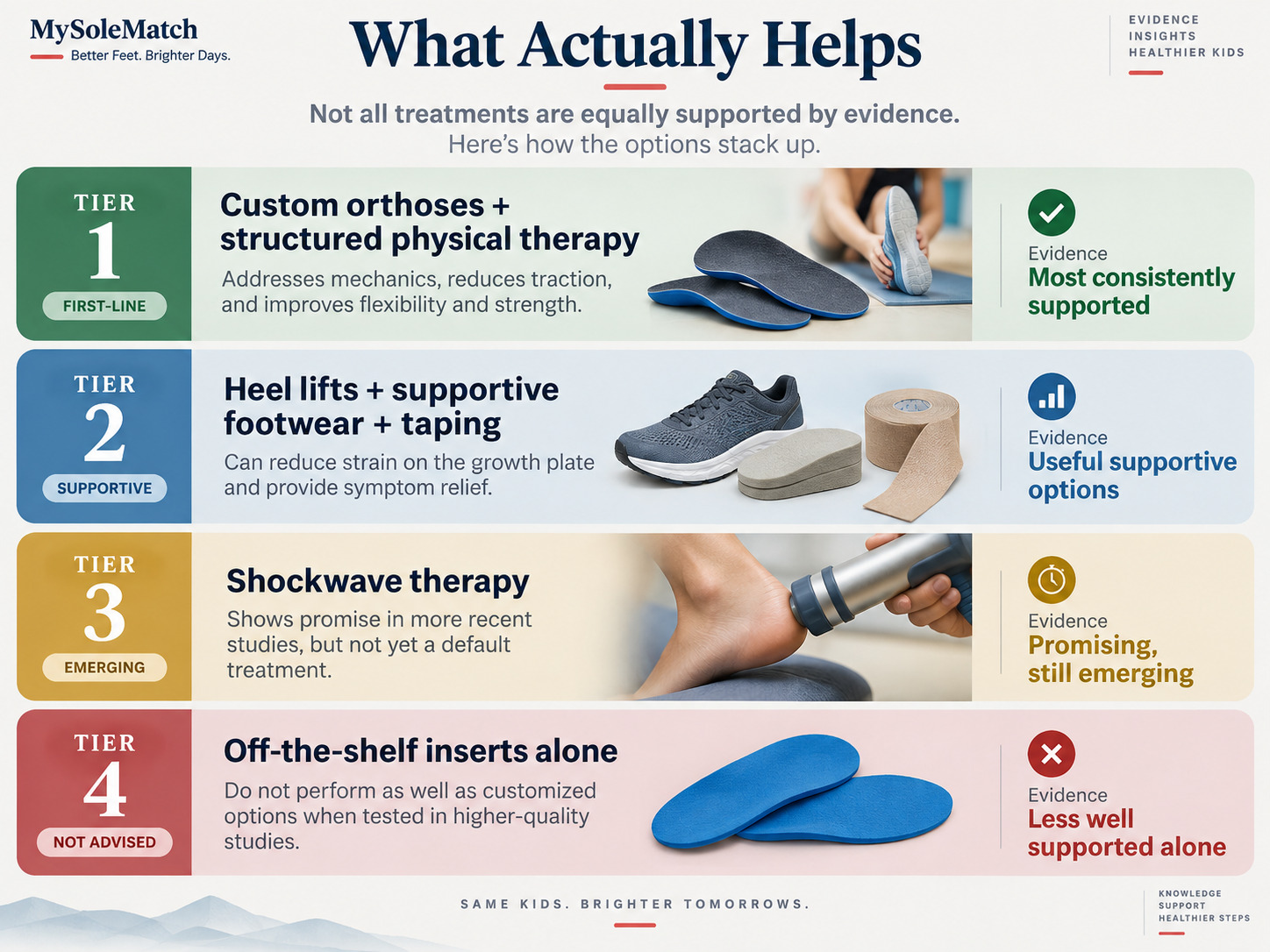
What Actually Helps
Not all treatments are equally supported by evidence. Custom orthoses and physical therapy lead the tiers most consistently backed by research.
A 2024 systematic review pooling eight randomized controlled trials, insoles, therapeutic exercise, kinesiology taping, and foot orthoses, found that conservative treatment generally reduced pain and improved function. The trials varied enough in design and quality that the review stopped short of naming one single best approach, average methodological quality was decent, not uniformly strong.
Looking at how that evidence tends to get applied in practice, a rough hierarchy emerges: custom orthoses and structured physical therapy, calf and Achilles stretching, ankle-strengthening exercises, show up as the first-line approach most consistently supported. Heel lifts, supportive footwear, and kinesiology taping tend to function as second-line or supportive additions rather than standalone fixes. Shockwave therapy appears in more recent literature as an emerging option, not yet a default. And one specific, testable claim did not hold up well: a 2016 twelve-month randomized trial comparing footwear and orthotic strategies head-to-head found that off-the-shelf, non-customized inserts underperformed more tailored approaches, a useful, specific counterpoint to "any heel cup from the pharmacy will do."
None of this is a protocol for you to follow at home. It's context for the conversation worth having with whoever examines your child, orthoses, exercises, and footwear aren't interchangeable, and which combination makes sense depends on specifics a page like this can't see.
Does my child have to stop sports?
This is usually the question parents actually came here for, and it's also the one place this piece will resist giving you a clean answer, on purpose.
Sever's is described consistently in the literature as self-limiting, meaning it resolves on its own once the growth plate finishes maturing and fuses, typically by the mid-to-late teens. That's genuinely reassuring: this isn't a condition a child carries into adulthood. But "it resolves eventually" and "your child should stop playing right now" are two different questions, and the research doesn't support a blanket answer to the second one.
The most concrete real-world data on this comes from a ten-year retrospective study of a German youth soccer academy, tracking 19 athletes across 22 diagnosed episodes. Players underwent conservative treatment, rest, ice, calf stretching and strengthening, followed by a stepwise, function-based return to play, cleared once pain-free with strength and movement comparable to the unaffected side. Actual recovery time ranged enormously, from 14 days to 311 days, with bilateral and recurrent cases taking substantially longer than one-off, single-sided episodes. That wide real-world range is itself the point: a universal number of weeks doesn't reflect what actually happens, recovery is guided by function and symptoms, not a calendar.
What that means practically: a flare-up during a growth spurt might call for real activity reduction for a while, and a milder presentation might not. Both are legitimate outcomes of the same diagnosis. That's a decision that belongs to whoever is actually examining your child and knows their sport, their training load, and how their symptoms are trending, not something a general guide can responsibly hand you a fixed number for.
What we can say with confidence, and what we can't
Girls typically present earlier than boys due to earlier growth spurts, both within the broader 8-15 age range
Multiple independent sources, including a 4-year, ~21,000-patient hospital record study
EstablishedBody weight and activity level are not well-supported risk factors on their own
2011 prospective risk-factor study
SupportedLimited ankle dorsiflexion is the most consistently studied factor associated with the condition
2023 systematic review, 11 studies, 1,265 children
EstablishedConservative treatment (orthoses, exercise, taping) generally improves pain and function
2024 systematic review, 8 randomized controlled trials
SupportedOne universal device, insole, or fixed rest period works best for every child
Not supported, evidence favors individualized, symptom-guided management
Marketing claimClosing
Sever's disease sounds more frightening than it usually is. It's common, it's self-limiting, and decades of research point toward the same conclusion: manage the load, address the tightness driving the traction, and let a growing child's body finish the job it's already doing. What the evidence doesn't support is a single fixed protocol that applies the same way to every child, which is exactly why the right next step, if your child is dealing with this, is the same one it's always been: a conversation with the person actually examining their heel, armed with better questions than you had before you read this.
Not sure whether it's time to have that conversation? See When to See a Podiatrist or find a provider near you through Find a Podiatrist.